
Last updated October 30, 2026
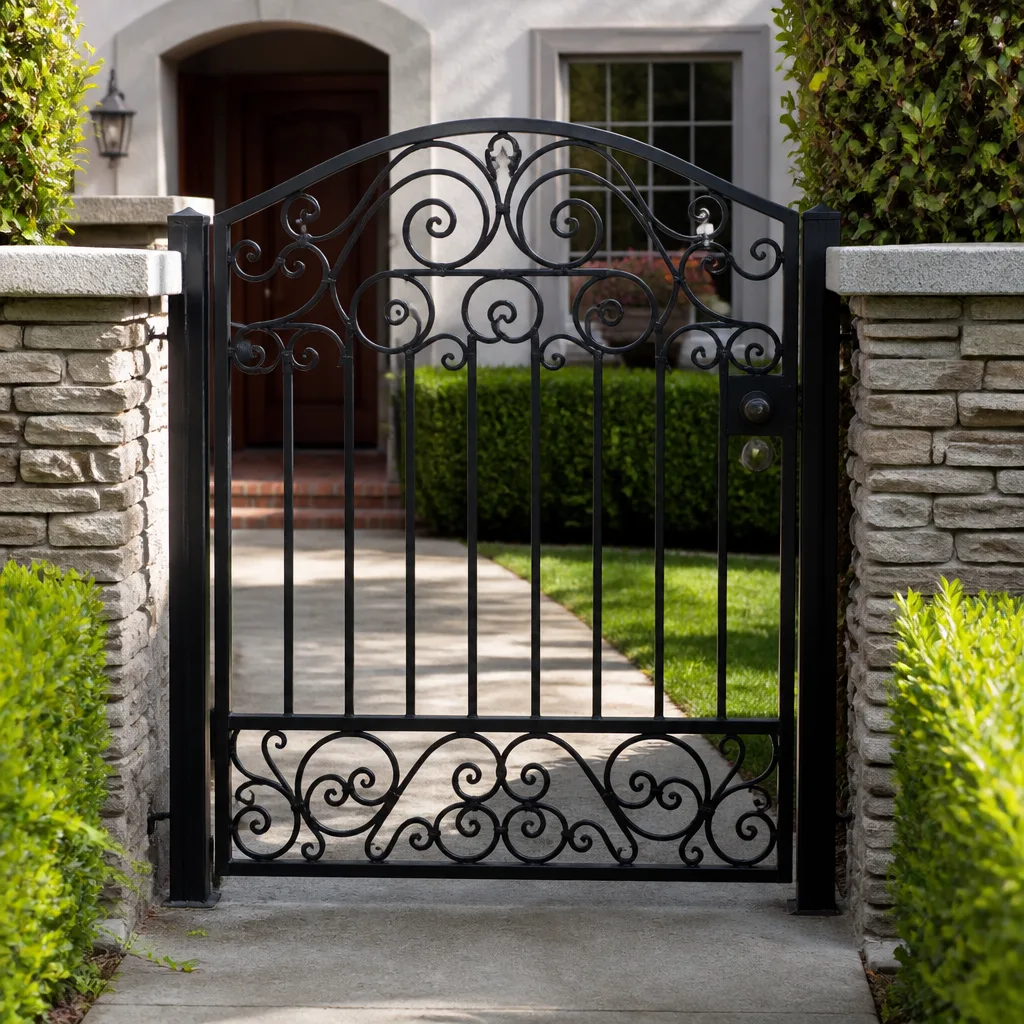 Wrought iron
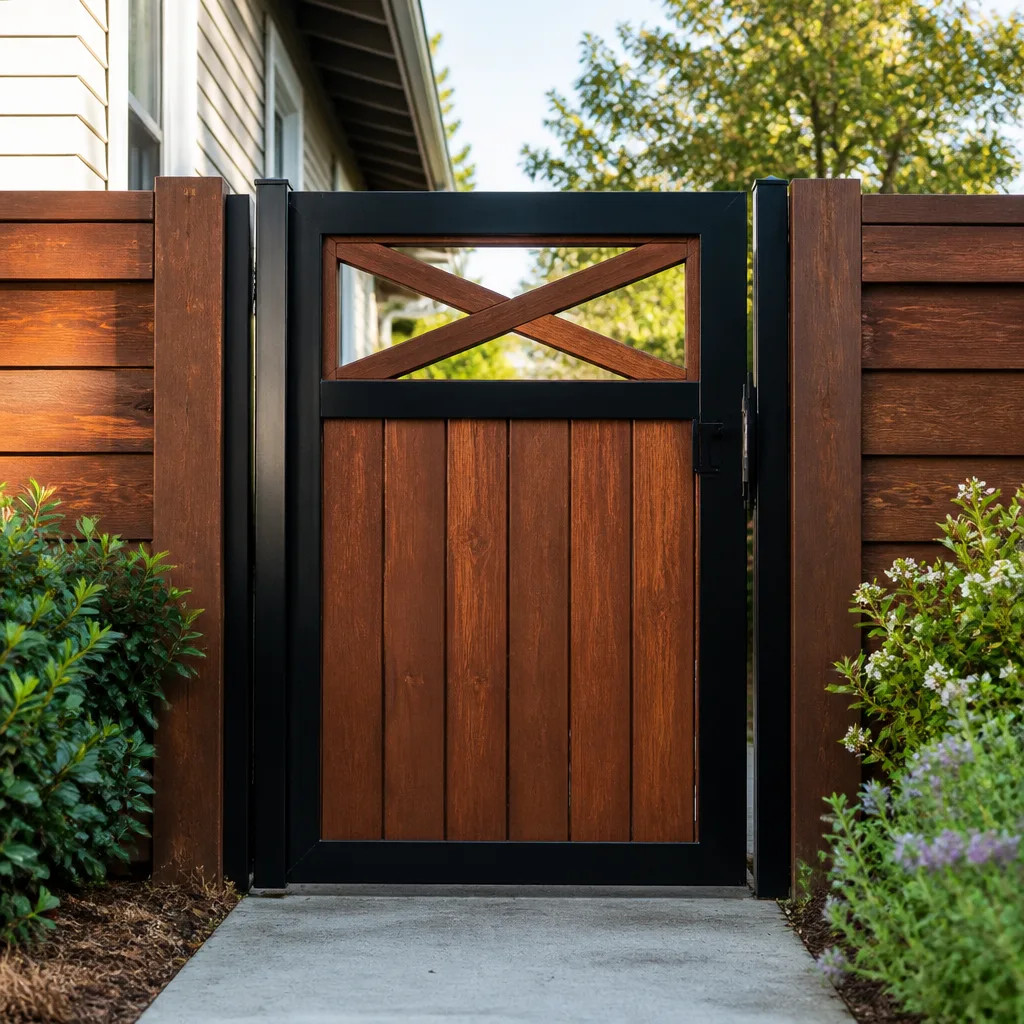 Wood & steel frame
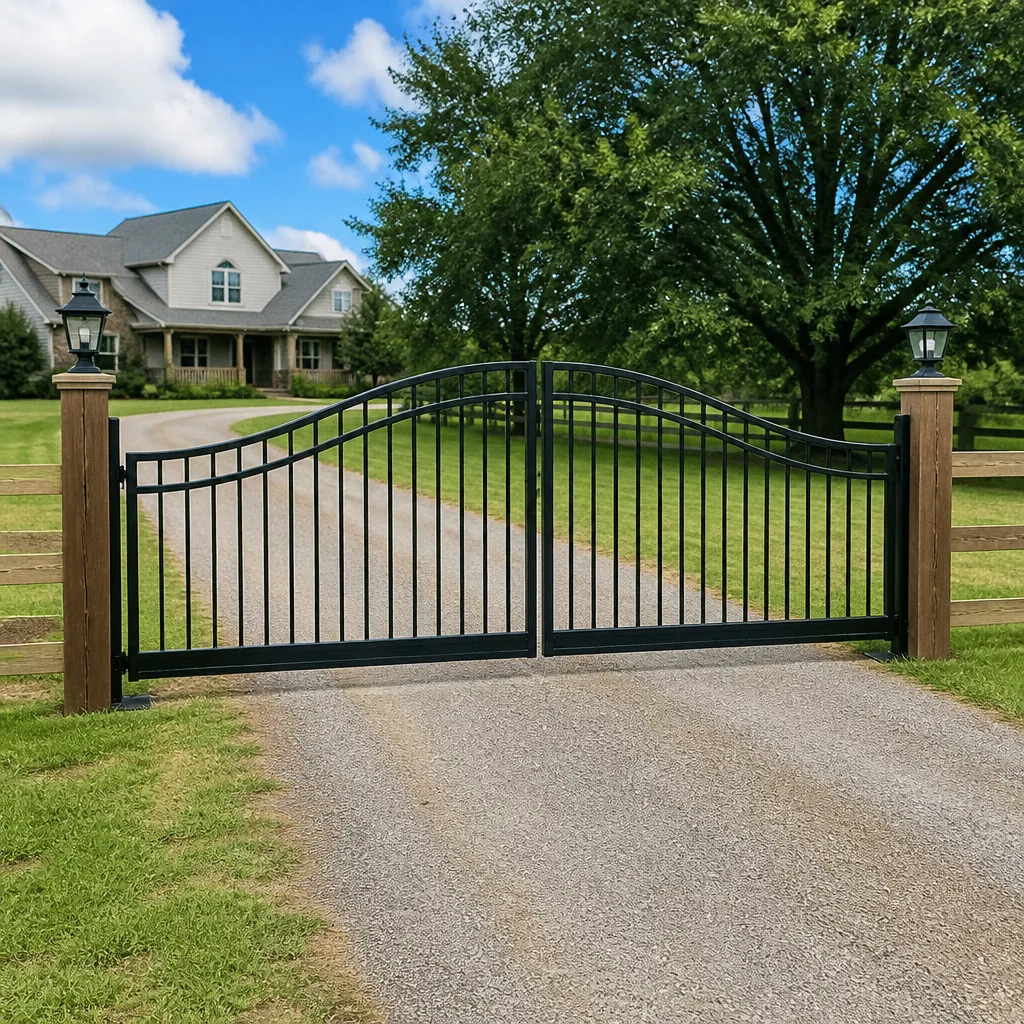 Farm & ranch
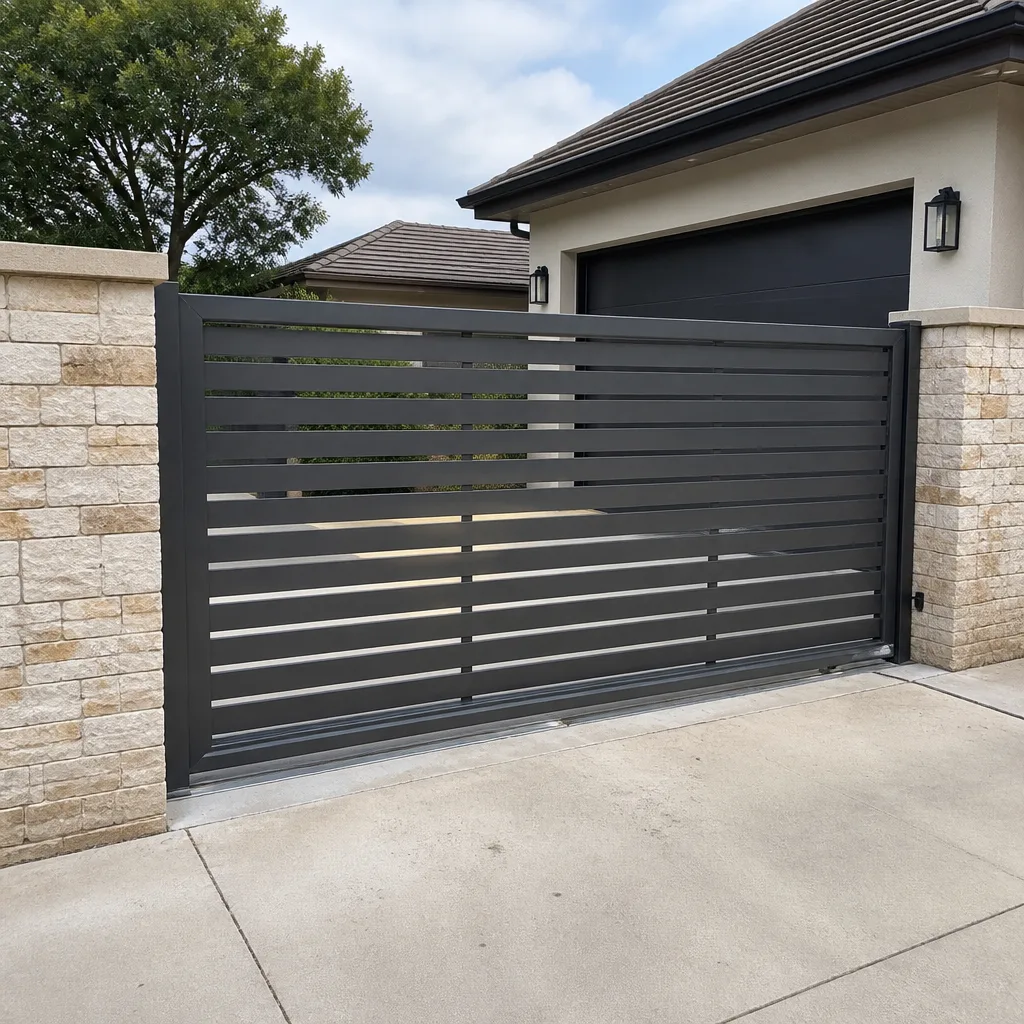 Sliding driveway gates
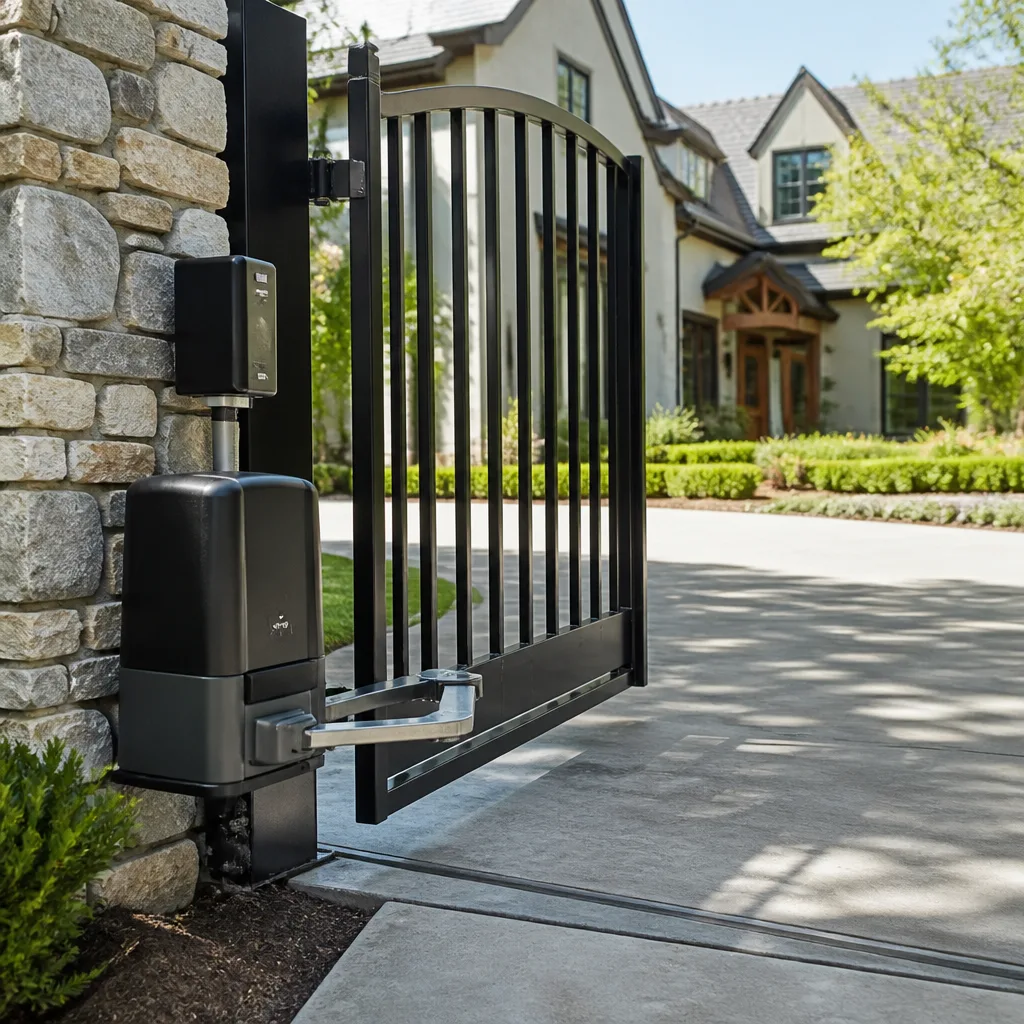 LiftMaster operators
Free on-site gate assessment - hinges, posts, and your LiftMaster or Nice gate operator checked before anything is quoted
The assessment is free and the quote is the invoice.
Get your free estimateGate Repair Permits, Codes & Inspections in CA: What You Need to Know
A gate motor swap sounds like a simple repair, but in California, replacing an operator on a vehicular gate that serves a multi-family or commercial property legally requires a our Gate Repair services to include a UL 325 entrapment protection audit. Skipping that audit exposes the homeowner to liability that insurance won’t cover. Most Fontana homeowners we talk to have no idea that a simple repair can trigger a permit requirement, and the line between maintenance and construction is drawn in a place very few people expect. This guide closes that knowledge gap so you don’t inherit a code violation at resale.
Quick Answer
In California, gate repairs that replace the operator, alter the gate’s structural frame, or modify safety devices on multi-family and commercial properties require a building permit and a UL 325 compliance check. Simple part swaps like replacing a wheel, hinge, or keypad on a single-family residential gate are exempt maintenance under the California Building Code and typically need no permit. In Fontana, the Building & Safety Division processes gate-related permits, and approvals for straightforward operator replacements generally take 5 to 10 business days once the application is complete. For Gate Repair Warning Signs: A Fontana Homeowner’s Reference Guide, see our related resource.
Styles & brands we work with
Table of Contents
- Which Gate Repairs Trigger a Permit in California
- UL 325 Entrapment Protection: The Federal Safety Standard
- How the City of Fontana Processes Gate Permits
- HOA Gate Rules vs. Municipal Code: Which Controls
- Checking a Previous Owner’s Gate Permit Before Buying or Selling in Fontana
- Maintenance That Never Requires a Permit
- What Gate Permits and Inspections Cost in Fontana
- Common Mistakes to Avoid
Which Gate Repairs Trigger a Permit in California
California Building Code Section 1008 governs gates and doors that serve as part of a means of egress. The code distinguishes between repairs that restore a gate to its original condition and alterations that change how the gate operates or is protected. That distinction is where most homeowners get lost.
The state’s position is straightforward once you see it laid out. A replacement of a failed circuit board inside an existing operator is a repair. Swapping the entire operator for a different model is an alteration. Fixing a bent hinge is maintenance. Welding a new steel frame member because the old one rusted through is structural work. The permit triggers follow that logic.
Here is what actually requires a permit in California:
- Operator replacement on any gate serving a multi-family property (three or more units) or a commercial site. This is not optional. The California Electrical Code and Building Code both treat this as an alteration to a means-of-egress component.
- Any structural modification to the gate frame, posts, or mounting hardware. Cutting, welding, or replacing structural members changes the gate’s load characteristics and must be reviewed.
- Adding or relocating a pedestrian gate adjacent to a vehicular gate. This changes egress patterns and may affect fire department access requirements.
- Installing a new gate where none existed before, regardless of property type. This is new construction, not repair, and always requires a permit.
- Changing a gate’s swing direction or leaf configuration. A single-swing gate converted to a bi-parting gate alters the load on the posts and the operator, and affects safety sensor placement.
In Fontana specifically, the city follows the California Building Code with no major local amendments that loosen these requirements. The Building & Safety Division treats vehicular gates as both structural elements and electrical installations, which means a permit application may route through both plan review desks. Our shop has seen customers buy a Fontana home only to find the previous owner swapped a Viking operator for a Ghost Controls unit with no permit and no safety-edge retrofit. The fix cost more than the original swap because the city required the entire installation to be brought up to current code, not just the part that changed.
UL 325 Entrapment Protection: The Federal Safety Standard
UL 325 is the federal safety standard for automatic gate operators, and it governs what protection devices must be present whenever a vehicular gate operator is installed or replaced. The standard is not optional and it is not a California quirk. It applies in all 50 states, and California’s Building Code incorporates it by reference into Section 1008.
The core requirement is that a powered vehicular gate must have at least two independent entrapment protection devices when the gate is operated automatically. For most residential and light commercial installations, that means a combination of the following:
- Contact sensors (safety edges) mounted on the leading and trailing edges of the gate that reverse the gate when they contact an obstruction. These must be present on any gate with a closing force that could entrap a person or vehicle.
- Non-contact sensors (photo eyes or photoelectric sensors) positioned to detect an object in the gate’s path. Photo eyes are the most common type, but loop detectors embedded in the driveway also qualify in some configurations.
- Inherent entrapment protection built into the operator itself, such as current-sensing reversal. Some modern BFT and Linear operators include this, but it is a secondary layer, never a standalone solution.
After any operator replacement in California, the entire entrapment protection system must be audited. That means verifying the photo eyes are aligned, the safety edges are connected and responsive, the reversal function works under load, and the gate’s force setting not exceed the UL 325 maximum of 40 pounds of closing force at the leading edge. Many older gate installations in Fontana, particularly those built before the 2001 UL 325 revision, have operators with no safety edges at all. Our Gate Repair Troubleshooting: Common Problems and How to Fix Them covers how to identify these issues. When we replace an operator on a gate like that, the new installation must meet current code, which often means adding a safety edge retrofit kit and repositioning the photo eyes.
A proper UL 325 audit takes about 45 minutes on a typical residential swing gate. It includes testing the gate with an obstruction at three points along its travel path, measuring closing force with a gauge, and logging the results. If you are replacing an operator yourself, there is no way to complete this audit without the force gauge and a working knowledge of the standard’s test method. That is one reason California’s permit process requires professional inspection on these projects.
How the City of Fontana Processes Gate Permits
The City of Fontana Building & Safety Division handles gate-related permits through a two-step process: plan review followed by field inspection. The application starts with the property address, a site plan showing the gate’s location relative to the property line and any pedestrian access, and a specification sheet for the operator being installed or the repair being done. A permit application fee is due at submittal, with the balance due when the permit is issued.
For a straightforward operator replacement on a single-family residential gate, Fontana’s plan review turnaround typically runs 5 to 10 business days. If the gate serves a multi-family or commercial property, the review goes through the fire department’s access review as well, which can add another week. Applications with incomplete site plans or missing operator specs are the most common cause of delay. The city will not issue a permit on a vague application, and a resubmittal restarts the clock.
Here is the typical sequence for a gate permit in Fontana:
- Submit the permit application with the site plan, operator manual, and structural details (if any structural work is being done).
- Pay the plan review fee. The city accepts online submittals through its permit portal for most residential gate projects.
- Receive plan review comments. If approved, the permit is issued with a list of required inspections. If not approved, correct the noted items and resubmit.
- Complete the physical work after the permit is issued. The city requires work to match the approved plans exactly.
- Call for the required inspections. For operator replacement, this is usually a single rough or final inspection where the inspector checks the UL 325 entrapment protection devices, the gate’s force settings, and the electrical connection.
- Receive the signed final inspection. This is the document you will need at resale to prove the gate was legally permitted.
Fontana’s inspectors are thorough on gate projects. They check that the photo eyes are mounted at the correct height, that safety edges are properly wired into the operator’s control board, and that the gate reverses on contact in all three test positions. We have seen permits pass on the first inspection when the work was done by a contractor who understood UL 325, and we have seen them fail on simple things like missing signage. UL 325 also requires warning signs to be posted on both sides of the gate, and inspectors in Fontana do check for them.
HOA Gate Rules vs. Municipal Code: Which Controls
When a Fontana homeowner lives in a community governed by an HOA, gate work sits at the intersection of two rule sets. The HOA’s CC&Rs (covenants, conditions, and restrictions) govern aesthetic choices: gate style, finish color, height, and whether a particular brand or design is approved. The California Building Code and the City of Fontana govern safety and structural requirements: permits, UL 325 entrapment protection, egress width, and setbacks. The two rule sets cover different things, and that is where the confusion starts.
The short answer is that municipal code always controls on safety and permitting matters. An HOA cannot approve a gate installation that violates the California Building Code, and an HOA cannot waive a permit requirement. If your HOA architectural committee says you can replace a gate operator without involving the city, the HOA is wrong, and following that advice leaves you personally liable for any code violation. The HOA’s authority to fine you for an unpermitted gate is a separate matter, but the city’s authority to require correction is absolute.
Where conflicts most often arise in Fontana is over gate appearance. An HOA may require a particular wrought-iron style that the homeowner wants to preserve, while a safety retrofit requires adding a safety edge strip that visually changes the gate’s bottom rail. In our experience, the solution is usually a black or dark-bronze safety edge profile that blends with the gate’s existing color. We have also handled cases where the HOA required a specific operator brand because of a neighborhood-wide access control system, and the homeowner needed that operator wired into an existing pedestrian gate without triggering a separate permit. Navigating that requires reading both the HOA’s CC&Rs and the city’s permit requirements at the same time, which is something a specialist does as a matter of course.
If you are buying a Fontana home with a gated entry in an HOA community, request three things from the seller: the HOA’s current gate specifications, the city’s permit records for the gate, and the maintenance history for the operator. A gate that looks fine on a walkthrough can have an operator that predates UL 325’s 2001 entrapment protection requirements, and correcting that after closing is your expense, not the seller’s.
Checking a Previous Owner’s Gate Permit Before Buying or Selling in Fontana
Unpermitted gate work is one of the most common items discovered during a Fontana home sale, and it can delay closing or knock thousands off a sale price. If you are buying a home with a powered gate, spend fifteen minutes checking the city’s records before you sign anything. If you are selling, do the same check before you list. Fixing the problem before escrow is always cheaper than negotiating it during escrow.
Here is how to check whether a Fontana property’s gate was properly permitted:
- Go to the City of Fontana Building & Safety Division’s permit lookup portal or visit the counter at City Hall. You will need the property address and the APN (Assessor’s Parcel Number), which is on the property’s tax bill.
- Search for permits containing the words “gate,” “automatic gate,” “gate operator,” or “vehicular access.” If there is no such permit, the gate’s installation was never reviewed.
- If a permit exists, pull the permit history to see whether it received a final inspection sign-off. An issued permit without a signed final inspection is still an open code issue.
- Request the approved plans if they are available. These show what was actually approved versus what may have been built differently later.
- Compare the gate on the ground to the approved plans. Look for differences in operator brand, gate leaf configuration, safety device placement, and signage.
One thing that surprises people is how often the gate on a Fontana property does not match the permit. A previous owner may have had a BFT operator on the plans, then replaced it years later with a Linear unit when the original failed, and never pulled a new permit. The gate works, the property sale looks clean, and then a sharp buyer’s inspector flags the mismatch. The seller either pays for a retroactive permit and a UL 325 compliance upgrade, or the sale stretches out while both parties argue over the cost.
For sellers, the economics are simple. A retroactive gate permit in Fontana typically costs less than $500 in fees, and a UL 325 safety-edge retrofit on a single swing gate runs in the $300 to $800 range depending on the gate’s construction. Escrow delays over a title contingency often cost more than that in holding costs alone. The case for checking early is strong.
Maintenance That Never Requires a Permit
Not every repair is a code event. The California Building Code exempts routine maintenance and minor repairs from permitting when the work does not alter the gate’s structure, operator, or safety systems. The line between maintenance and alteration runs right through the parts list.
Here is what California and Fontana treat as exempt maintenance:
- Replacing gate wheels, rollers, and track hardware. These are wear items. If the part number is the same and the mounting holes line up, no permit is needed.
- Lubricating hinges, chains, and drive mechanisms. This is preventative upkeep, not construction.
- Replacing a keypad, remote control, or receiver. Access control accessories are low-voltage devices, and swapping one for a compatible model is exempt. The exemption covers the accessory itself, not wiring changes to the operator’s power circuit.
- Adjusting the gate’s closing speed, force settings, or limit switches. These are operator adjustments within the manufacturer’s approved range. If the adjustment requires changing a control board or adding a module, it crosses into permitted work.
- Replacing a broken chain or belt with the same specification part. This is restoration, not alteration.
- Replacing a capacitor, transformer, or other internal electrical component inside the operator housing. This is component-level repair on the existing unit, which is generally exempt when done by a qualified person and does not change the operator’s listing.
The subtlety is in the phrase “same specification.” If you replace a broken chain with a stronger chain, that is an alteration because it changes the gate’s force characteristics. If you replace a failed control board with the same model from the same manufacturer, that is a repair. If you replace it with a different board because the original is discontinued, you have now changed the operator’s UL listing and likely triggered a permit review. That is one of the reasons we maintain a deep parts inventory for the brands we service, including BFT, Linear, Viking, and Ghost Controls. Finding the exact board keeps a repair on the exempt side of the line.
What Gate Permits and Inspections Cost in Fontana
Permit fees in Fontana are based on the project’s valuation, which the city calculates from the contractor’s cost estimate or a standard valuation table. For a typical single-family vehicular gate operator replacement, the permit fee runs between $180 and $400 depending on the project’s declared value and whether the plan review routes through the standard or expedited path. Structural modifications to the gate frame push the fee higher because the city adds a structural plan review charge.
Here is a realistic breakdown for a Fontana gate operator replacement on a single-family property:
- Permit application and plan review fee: $150 to $300, due at submittal
- Final inspection fee: typically included with the permit, but an additional re-inspection if the first inspection fails runs $75 to $150
- UL 325 entrapment protection retrofit (if the gate has no safety edges or photo eyes): $300 to $900 in parts, depending on whether the gate needs one or two safety-edge profiles and whether new photo eye brackets must be fabricated
- Contractor labor for the physical install and the compliance audit: $200 to $600 depending on the gate’s configuration and access
Multi-family and commercial gate permits cost more because the review includes fire department access verification, which is a separate fee line item. Budget $500 to $1,200 in total permit and inspection fees for a commercial gate operator replacement in Fontana. The exact number depends on the project and should be quoted before work begins. Any contractor who gives you a price without accounting for permits is giving you a price that will grow.
Common Mistakes to Avoid
- Assuming a gate motor swap is always a “repair.” On a single-family home with a like-for-like operator, it often is exempt. On multi-family or commercial property, it almost never is. The property type, not the size of the job, is what triggers the permit.
- Thinking the HOA’s approval covers the city’s requirements. An HOA cannot waive a building code or a permit requirement. You need both approvals, and they cover different things.
- Skipping the UL 325 audit because the gate “works fine.” A gate that opens and closes can still have no functional entrapment protection. If a child is injured and the audit was never done, the homeowner’s insurance may deny the claim outright.
- Buying a gate operator online and installing it without checking the listing compatibility. A UL 325 listed operator is only compliant when installed with the entrapment protection devices the manufacturer specifies. Mixing brands of safety edges, photo eyes, and operators without verifying compatibility voids the compliance.
- Not pulling the permit history before buying a Fontana home with a powered gate. Unpermitted gate work discovered during escrow either kills the deal or costs the seller thousands in retroactive fees. Check the records early.
- Using a handyman for an operator replacement on a multi-family gate. The city will require a permit, the handyman will not pull it, and the owner is left with an illegal installation. Multi-family gate work belongs with a licensed contractor who carries the responsibility.
- Ignoring the required UL 325 warning signage. Fontana inspectors check for the warning signs on both sides of the gate. Missing signs are a cheap fix but a failed inspection.
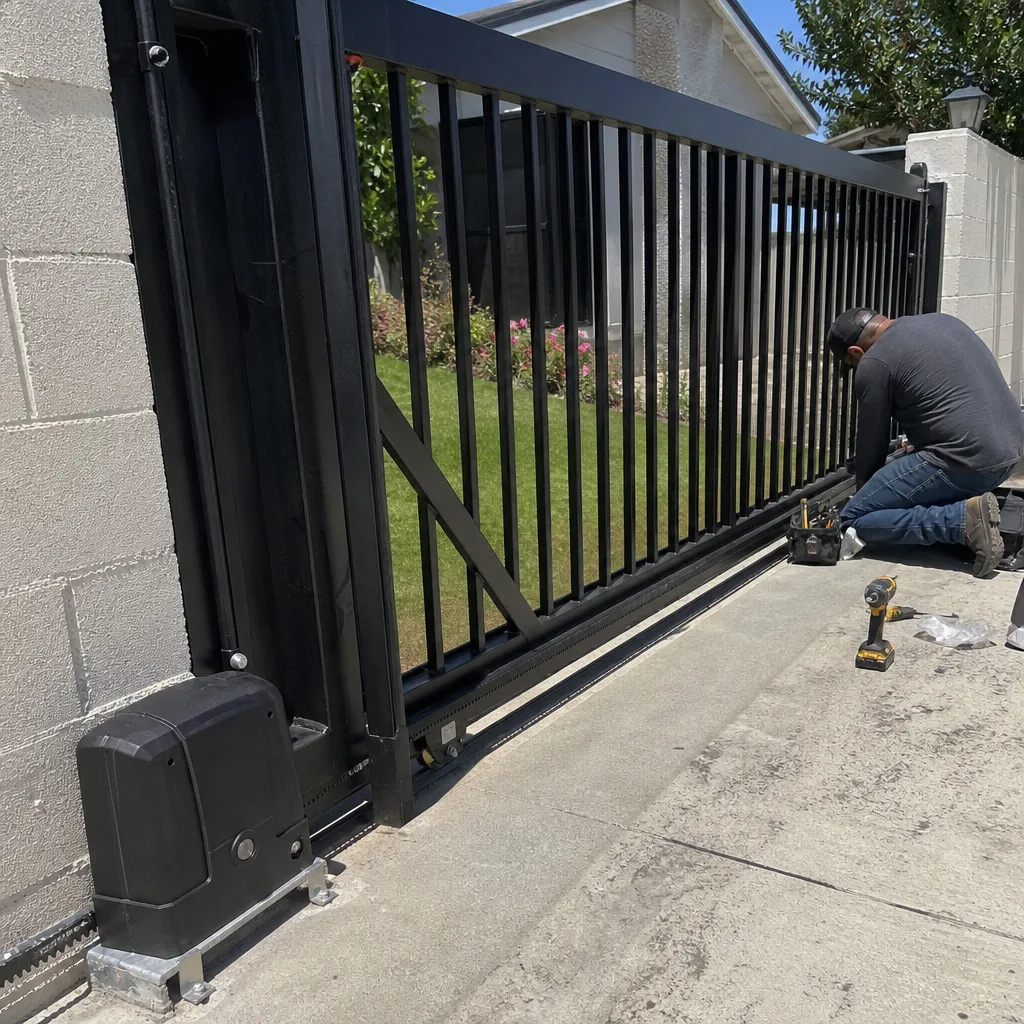
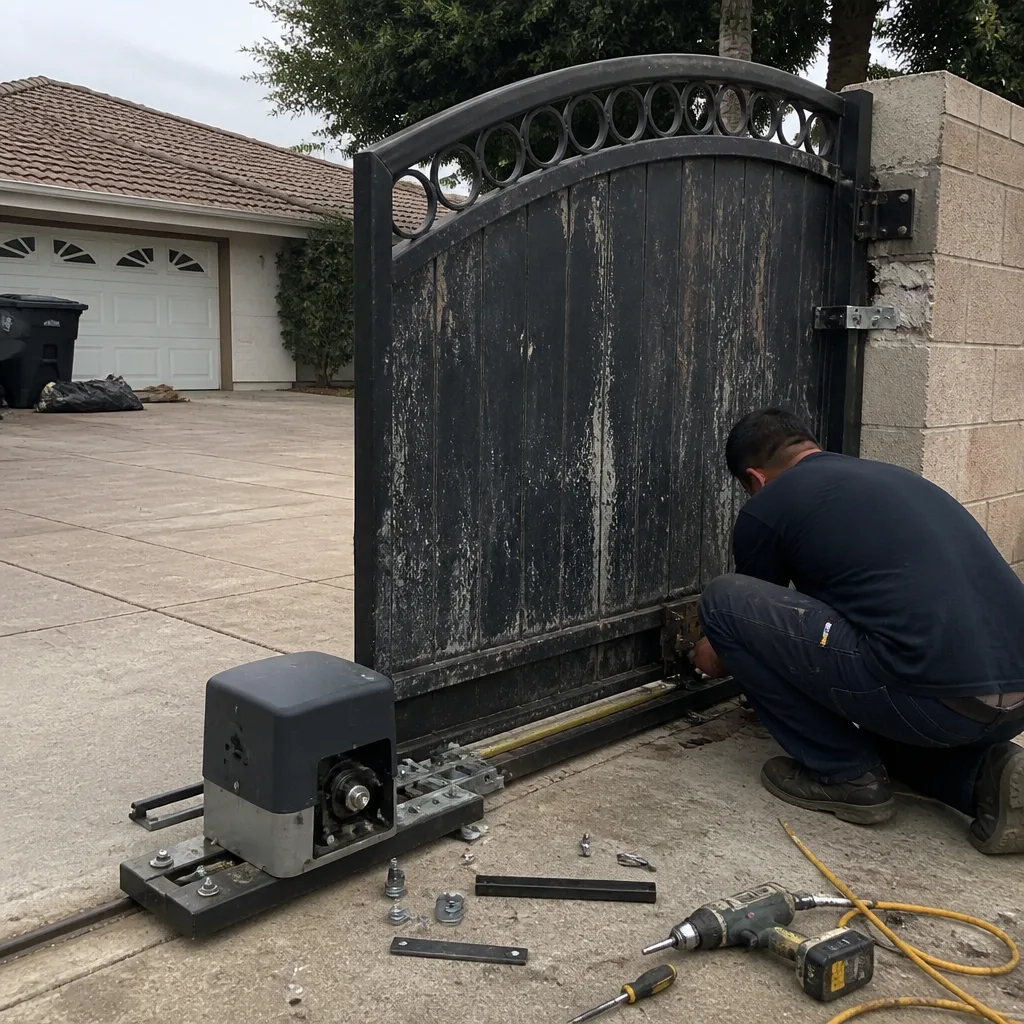
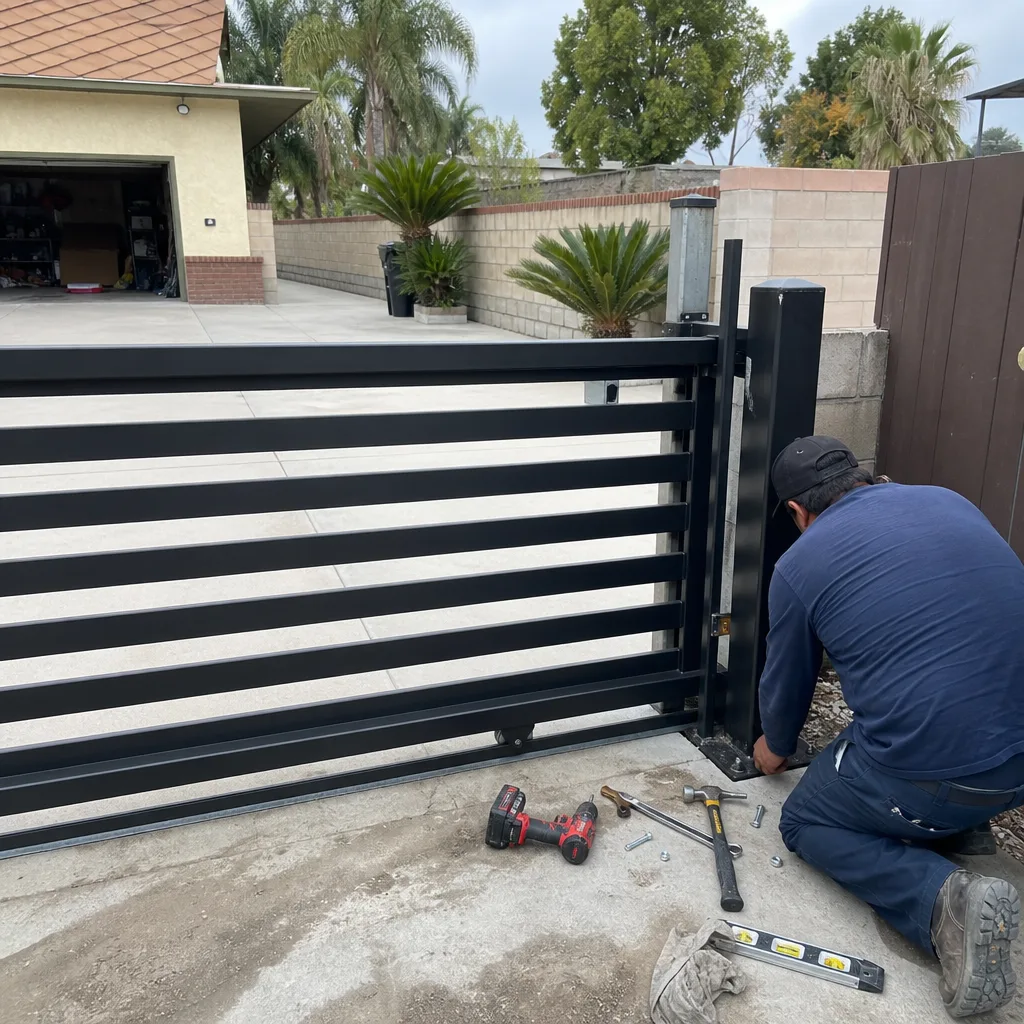
See the difference
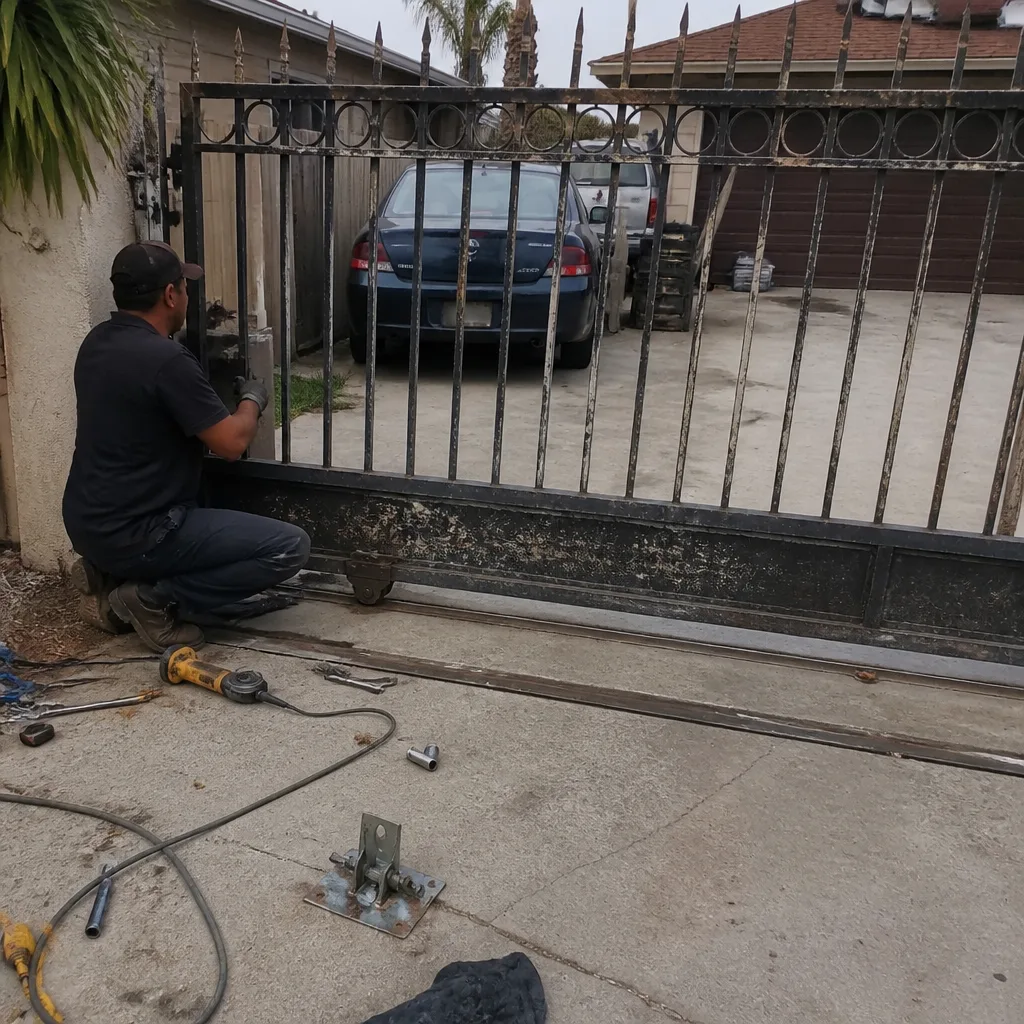 Before
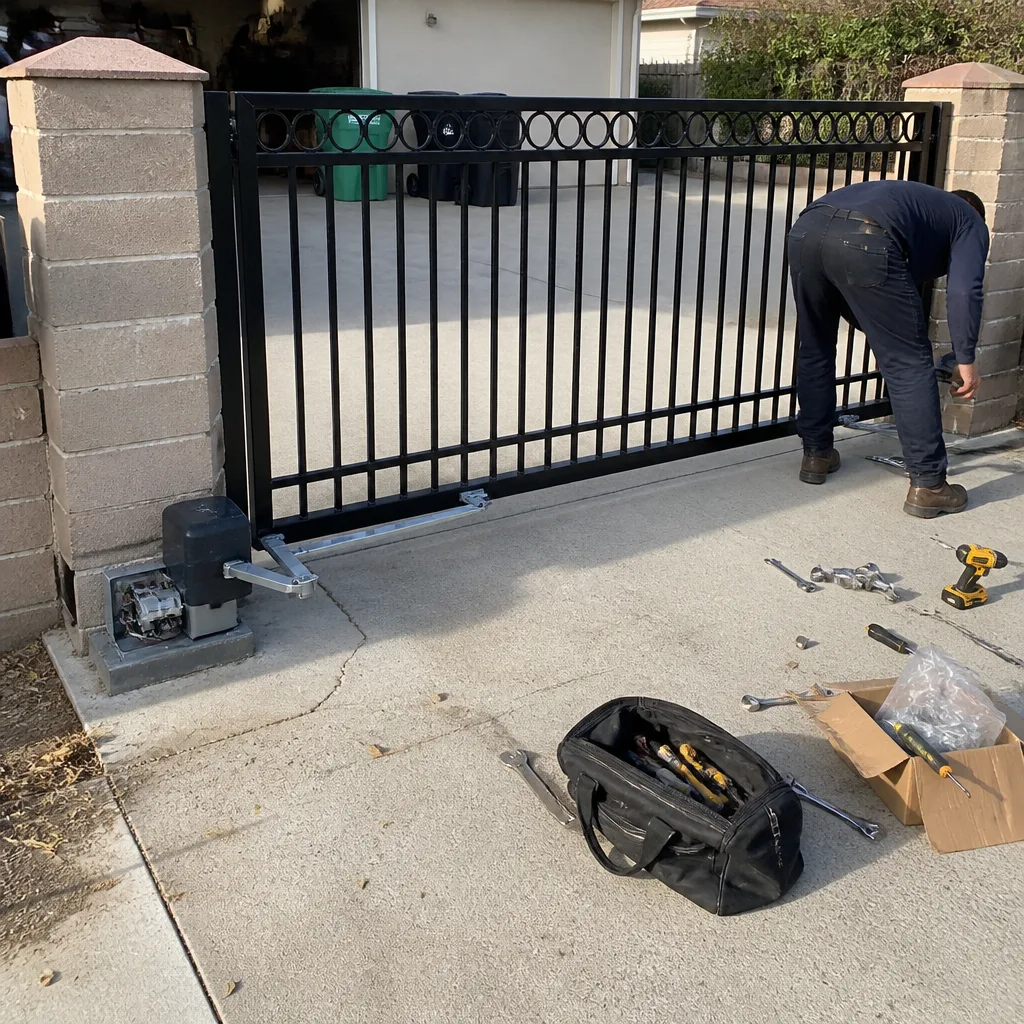 After
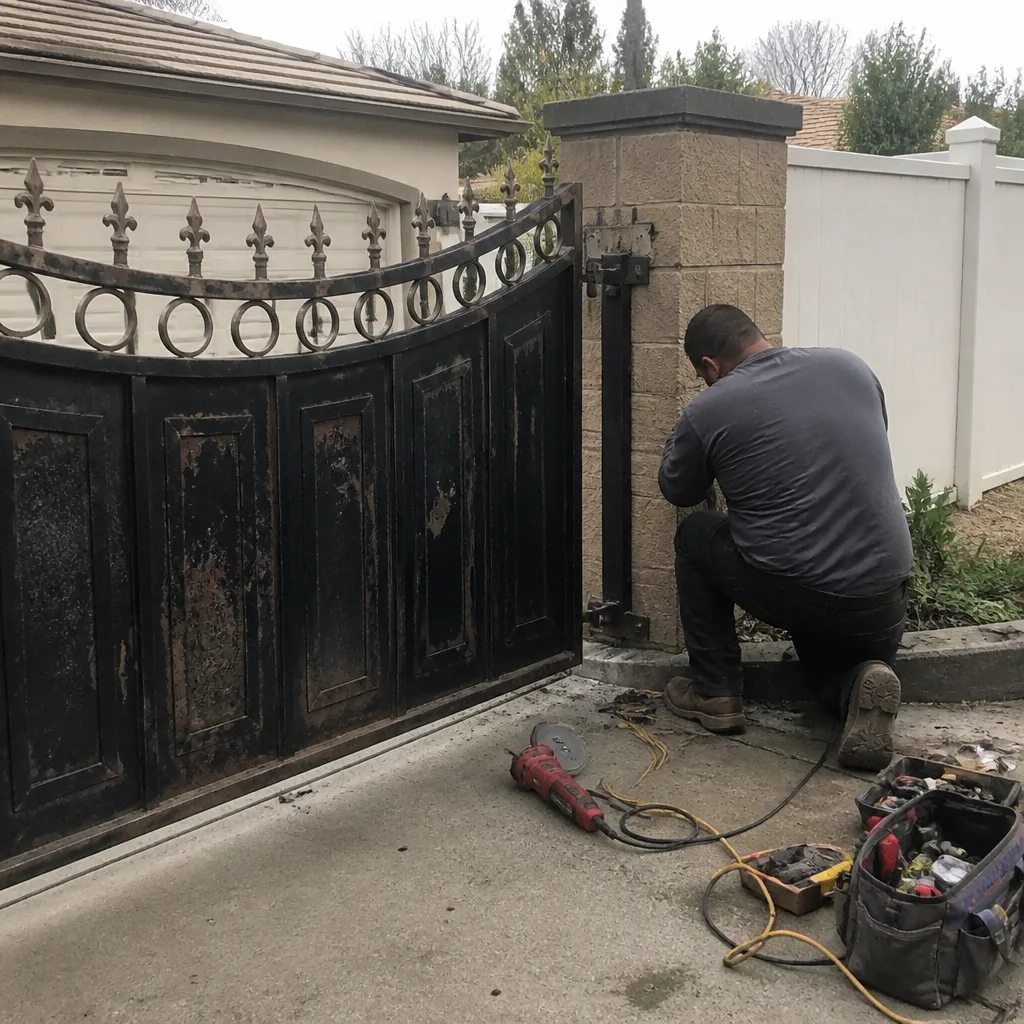 Before
 After
 Before
 After
When to Call a Professional
If your gate serves a multi-family or commercial property, any operator replacement or structural repair belongs with a contractor who understands UL 325 compliance and the Fontana permit process. The same goes for any repair where safety devices are missing, damaged, or questionably wired. A gate that reverses inconsistently, fails to stop on an obstruction, or makes a grinding noise when reversing has an entrapment protection problem, and that is not a DIY fix. If you are selling a Fontana home and the gate’s permit history is unclear, a professional assessment before listing can save you from an escrow headache. Estate Gate Repair offers free estimates in Fontana, call (866) 893-2220. We are gate-only specialists, from the motor to the control board, and we diagnose first and replace only what is needed.
Frequently Asked Questions
On a single-family residential property, replacing a failed operator with a like-for-like unit is generally exempt maintenance and does not require a permit, provided the safety devices remain unchanged. On a multi-family or commercial property, an operator replacement is an alteration to a means-of-egress component and does require a permit under California Building Code Section 1008. When we replace operators on Fontana multi-family gates, we pull the permit and complete the UL 325 audit as part of the job. Call (866) 893-2220 if you are unsure which side of the line your job falls on.
UL 325 is the federal safety standard for automatic gate operators, and it applies to every powered vehicular gate in California regardless of property type. It requires at least two independent entrapment protection devices and sets limits on closing force. If your gate was installed before 2001 or has never had its operator replaced, it may not meet the current standard, and a retrofit may be due.
A straightforward operator replacement permit on a single-family Fontana property typically takes 5 to 10 business days from submittal to issuance. Multi-family and commercial gate permits take longer because they include fire department access review. The most common cause of delay is an incomplete application or missing operator specification sheets.
Your HOA can regulate the appearance and sometimes the brand of the operator if the community uses a unified access control system. However, the HOA cannot block a repair that is required for safety, and the HOA cannot waive the city’s permit or code requirements. Municipal safety code always controls.
The unpermitted work becomes a title disclosure issue that the buyer’s inspector or lender will typically flag. Sellers either pay for a retroactive permit and compliance upgrade or negotiate a credit off the sale price. Checking the gate’s permit history before listing is cheaper than negotiating it during escrow.
Yes, and this is one of the most common retrofits we perform in Fontana. The process involves mounting an edge profile on the gate’s leading and trailing edges, wiring it into the operator’s control board, and then testing the reversal function at multiple points along the gate’s travel. We work on the brand you already have, and handle the retrofit without requiring a full operator replacement. Call (866) 893-2220 for a free estimate.
The Bottom Line
California’s gate code requirements sit at the intersection of UL 325 federal safety standards, California Building Code Section 1008, and local Fontana municipal amendments. For more guides & resources on navigating these requirements, explore our blog. Most repair contractors either don’t know all three or don’t tell you when your repair triggers a permit requirement. The practical takeaways are simple: know whether your property type triggers a permit, never skip the UL 325 entrapment protection audit after an operator replacement, and check the permit history before you buy or sell a home with a powered gate. If the gate serves a multi-family or commercial property, use a specialist who handles both the mechanical and electrical sides of the system.
Written by the team at Estate Gate Repair, serving Fontana since 2015.